Neurostarter
Your Data-Driven Tool for Neuroscience-Powered Coaching
NeuroStarter connects emotions and experiences to brain chemistry, helping you identify the best activities for boosting your clients’ emotional, physical, and social well-being. Seamlessly integrate these actionable insights into your coaching system, and personalize your approach with neuroscience-driven strategies tailored to each client’s unique neurobiology.
NeuroStarter
Connects emotions and experiences to brain chemicals for a deeper understanding.
Identifies key activities to boost your client’s emotional, physical, and social well-being.
Turns complex neuroscience into practical, actionable strategies.
Integrates seamlessly into any coaching system, enhancing your methods.
Customizes coaching based on each client’s unique neurobiological profile.
How to get stared
Register for Free Access
- Register with your email for immediate access to the Neuro Starter tool.
- Explore the fundamentals of neurotransmitters, neuroplasticity, and their role in emotional and behavioural change.
Attend a Free "How to Use" Session
- Join a free live community session to learn how to navigate and use the Neuro Starter tool.
- Discover the features, complete an assessment, and understand how to get the most from the app.
- Ask questions and gain confidence using the tool in your personal or professional practice.
Graduation and Certificate of Completion
- Attend the 120-Minute Masterclass and learn how to interpret results and apply neuroplasticity insights to support meaningful behaviour change.
- Develop practical strategies for using the results in coaching, leadership, health, or client conversations.
- Receive exclusive access to the Brain Hack Card Deck – an interactive resource for applying neuroplasticity concepts with clients.
Why NeuroStarter?
Real Neuroscience, Easy Application, Lasting Impact
Neurostarter is your tool to apply neuroscience based principles in your coaching to revolutionize your current coaching approach and help your clients maximize coaching results with lasting impact.
Testimonials
Experiences from the Beta Test Group who transformed their practices with NeuroStarter
“A lot of useful information. Well explained.”

~ Sylvia Becker-Hill
“I just wanted to share that I think the sheet is amazing. And I would love to continue using it if that is OK? I think it is absolutely amazing. I’m very grateful - thank you.”

~ David Goodman
“This is brilliant - the transformation from the original seed idea is incredible. Congratulations to all involved. I have no doubt this will prove an immensely popular tool.”

~ Kim Goodwin
“Great , simple to understand - Congrats . Straight to the point for coaches and clients.”

~ Barry Downing
“The information in the Neurosheet is solid and comprehensive. Bravo!”

~ Kerrie Alanen
“The goal (e.g., reduce anxiety) and how to do it, and the related neurotransmitter is really effective. Coaches don’t need to be expert neuroscientists but have the core knowledge.”

~ Alice Penn
"It is a nice way for us to deepen the coaching and also to figure out ourselves how we are going to integrate that in our coach practice, which is so diverse and so different, and it was not prescriptive. You gave us possibilities."

~ Sonja Vlaar
Neurostarter is really important to help people understand that neuromodulation is not in isolation. What NeuroStarter does is give you a start. It helps you to understand the point of contact to the pathway and then the interventions can help create that pathway."
~ Greg Pitcher
Unlock Your Neuroplastician® Credential
Complete the training and earn the prestigious npn Neuroplastician® Credential.
This award is backed by leading neuroscientists, and marks you as an elite coach capable of integrating neuroscience into non-clinical practices.
📅 TBA
Free Community Session
Learn how to confidently use the Neuro Starter tool.-
Live walkthrough of the Neuro Starter platform
-
Discover key features and tools
-
Tips for getting the most from your experience
-
Live Q&A with an expert
-
Perfect for first-time users
A Special Gift for everyone Who Attends
At the end of the free group session, you will get an exclusive discount code that can be applied towards the 120 -minute Masterclass, giving you the opportunity to continue your learning and receive a certificate of completion at a reduced investment.
📅 TBA
120-Minute Masterclass + Certificate
Master the science behind the results and earn your Certificate of Completion.-
120-minute live interactive masterclass
-
Learn how to interpret Neuro Starter results
-
Apply neuroplasticity insights to drive behaviour change
-
Exclusive Brain Hack Card Deck
-
Certificate of Completion
A Special Gift for everyone Who Attends
At the end of the masterclass, you will get an exclusive discount code that can be applied towards obtaining the npn Neuroplastician Credential giving you the opportunity to get another credential based on your current learnings.
Become an Expert in Neuroscience-Driven Coaching
NeuroStarter gives you the knowledge to apply cutting-edge science of neuroplasticity to support your clients toward peak performance and lasting change.
Learn how neurotransmission fuels neuroplasticity.
Craft personalized interventions that drive lasting change.
Ensure Your current coaching is based on the science
Bonus Resource Included
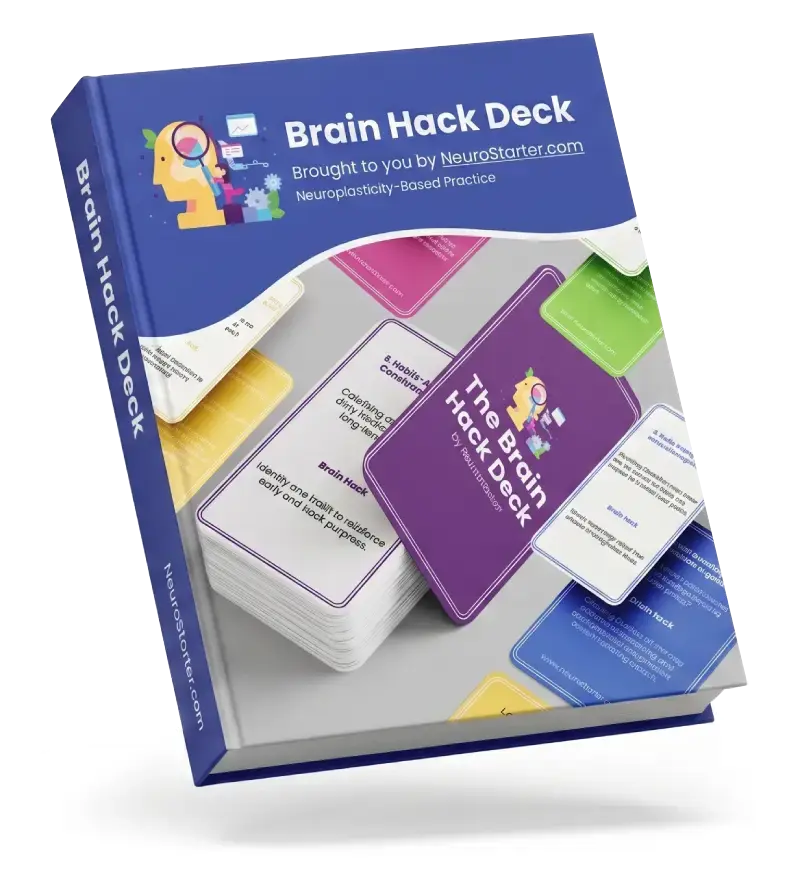
As part of the 120-Minute Masterclass, you'll receive exclusive access to the Brain Hack Card Deck, a practical, interactive coaching tool designed to help you turn neuroplasticity insights into meaningful action.
- Use the cards to spark powerful conversations
- Challenge limiting thinking
- Build new habits, and support lasting behaviour change with clients, teams, or yourself.
“This isn’t just a bonus resource. It’s a powerful coaching tool you’ll rely on long after the masterclass to drive deeper conversations and better outcomes.“
Greg Pitcher, Master Neuroplastician (M.npn)
FAQ
Is a background in neuroscience needed?
A background in applied neuroscience is not required but recommended.
What is neuroplasticity?
Neuroplasticity is the brain’s remarkable ability to reorganize and form new neural connections, enhancing its capacity to learn and adapt. As you learn new skills or information, your brain becomes better at learning and processing additional knowledge. Here’s how it works:
- Strengthening Neural Connections: When you learn something new, your brain creates or strengthens connections between neurons (nerve cells). The more you practice a skill or reinforce knowledge, the stronger these neural pathways become, making it easier to recall and apply that information in the future.
- Creating New Pathways: As you expose your brain to new experiences and info, it adapts by forming new neural pathways, which enhances your brain’s capacity to handle and integrate more complex info over time, improving learning efficiency.
- Enhanced Cognitive Flexibility: This keeps the brain flexible and adaptable. When you consistently challenge your brain with new material, it becomes better at problem-solving, adapting to new information, and thinking creatively.
- Building Cognitive Reserves: Lifelong learning helps build a “cognitive reserve,”- the backup system of mental capabilities. This helps protect against cognitive decline as you age, ensuring your brain remains sharp and capable of learning even later in life.
- Boosting Dopamine Levels: Learning something new triggers the release of dopamine, and other neurotransmitters associated with reward and motivation. This makes you feel good, reinforcing the desire to keep learning, which leads to continuous neural stimulation and growth.
Essentially, the more you learn, the more your brain develops its ability to learn, making it easier to grasp new concepts and adapt to new challenges.
How are Neural Networks and AI relevant?
Neural networks are computational models inspired by the human brain, designed to recognize patterns and make predictions by processing input through interconnected layers of nodes or “neurons.” Recent advancements in high-resolution electron microscopy allow for detailed imaging of neural connections or synaptic connectomes, mapping how neurons communicate. However, images don’t always reveal whether a connection is excitatory (activating) or inhibitory (slowing down). This distinction depends on the neurotransmitter each neuron releases (e.g., acetylcholine, glutamate, GABA, dopamine, etc.).
To tackle this, researchers (2024) trained artificial neural networks to predict the type of neurotransmitter from microscopic images. The model has shown high accuracy of 87% for individual synapses and 94% for neurons. By identifying subtle ultrastructural differences, this system helps map neurotransmitter functions across the brain and highlights how neurons developing together tend to use one of the fast-acting transmitters (like acetylcholine).
Advanced Neuroimaging Insights
Recent machine learning and advancements in mapping neural networks, like those from the 2024 study by Nils Eckstein et al., offer new AI-driven methods that can predict neurotransmitter action types with high accuracy. This in turn provides valuable insights to apply this tool for understanding neurotransmitter functions to ensure coaching interventions are most effective. Understanding various neurotransmitter types’ role on emotional and behavior change has shown with high accuracy, what interventions build neuroplasticity and sustain new habits for clients. These AI-driven methods offer practical insights, allowing understanding of research into how neuronal circuits affect learning, behavior, and cognitive processes as per recent findings published in Cell Journal, 2024
More information: Provided by Howard Hughes Medical Institute. Nils Eckstein et al, Neurotransmitter classification from electron microscopy images at synaptic sites in Drosophila melanogaster, Cell (2024).DOI: 10.1016/j.cell.2024.03.016. cell.com/cell/fulltext/S0092-8674(24)00307-6?_returnURL=https%3A%2F%2Flinkinghub.elsevier.com%2Fretrieve%2Fpii%2FS0092867424003076%3Fshowall%3Dtrue
What is the Neurostarter Tool about?
NeuroStarter is a comprehensive tool designed for non-clinical practitioners and coaches to enhance their practice by integrating insights from neuroplasticity and the function of neurotransmitters into their current coaching strategies. The effective graduation of the NeuroStarter Training and effective application of this tool as part of coaching or other non-clinical practice ensures to be awarded the Neuroplastician® credential. Here’s a breakdown of how the tool might be used based on the latest advancements in neuroimaging and neurotransmitter classification noted from the research:
1. Improving Client Outcomes
Client Observations:
- Use detailed information from NeuroStarter to better understand clients’ emotional and behavioral states.
- This understanding is informed by the latest research on neurotransmitters and neural connections.
- This can help tailor your observations and interventions (neuroception and body-scans) to the client’s needs.
2. Identifying Neurotransmitters
Behavior and Emotions:
- Leverage the tool’s resources to identify which neurotransmitters are associated with specific behaviors and emotional states.
- For instance, knowing that dopamine is linked to reward and motivation can help you understand clients’ drive or lack thereof and help understand the reasoning and benefits of applying your tools.
- Another example in understanding the role of endorphins to mitigate chronic pain and related emotional experiences.
3. Brainstorming Interventions
Activity Influence:
- Use the insights from NeuroStarter to brainstorm and design interventions that influence neurotransmission positively.
- The tool helps the client the role of excitatory and inhibitory neurotransmission to motivate them and ensure they understand the impact of both kinds.
- For example, activities that boost serotonin levels could be suggested for clients experiencing depression or anxiety (inhibitory neurotransmission).
4. Monitoring Impact
Tracking Progress:
- Implement regular check-ins to assess the impact of the intervention you are coaching your client with.
- Use NeuroStarter to track how changes in activities are aligning with the desired outcomes and adjust strategies as needed.
- Tracking in relation to exhibitory and inhibitory neurotransmission helps build neuroplasticity and sustain new habits.
Enhance Accuracy:
- Help you pinpoint the exact neurotransmitter activities and their effects on behavior and cognition.
Speed Up Hypothesis Generation:
- Allow refinement of coaching strategies to be in line with neurotransmitter activities based on the neuroplasticity of client behavior change.
Incorporating these insights can improve the precision of your interventions and enhance the overall effectiveness of your coaching practice and understanding the role of a Neuroplastician® and toward receiving the credential and being available to use the Neuroplastician® (A.npn) designation.
What is the role of a neuroplastician?
A Neuroplastician® plays a crucial role in helping clients build neuroplasticity, allowing them to learn new skills, enhance emotional skills, well-being, and improve cognitive reserve, flexibility, and new social leadership abilities. Here’s how:
1. Building New Skills Through Personalized Learning
A Neuroplastician® works with clients to design personalized learning strategies that stimulate the brain’s ability to form new neural connections. By breaking down complex skills into manageable tasks and using repetition, they guide clients to gradually strengthen the pathways needed to master these skills. This tailored approach accelerates learning, making it easier for clients to acquire new abilities efficiently.
2. Enhancing Well-being Through Mind-Body Integration
Well-being is deeply connected to brain function. Neuroplastician® s use techniques such as mindfulness, cognitive behavioral strategies, and neurofeedback to help clients manage stress and regulate emotions. These practices optimize brain function by reducing mental fatigue, improving emotional resilience, and fostering a positive mindset. As a result, clients experience a greater sense of balance and well-being in their personal and professional lives.
3. Improving Cognitive Flexibility
Cognitive flexibility—the ability to adapt to new information and solve problems creatively—is key to success in today’s fast-paced world. Neuroplastician® s engage clients in exercises that challenge their thinking patterns, encouraging the brain to approach problems from different angles. By repeatedly confronting novel tasks and learning experiences, the brain becomes more adaptable and capable of handling complex cognitive challenges, leading to increased mental agility.
4. Strengthening Cognitive Reserve
Cognitive reserve refers to the brain’s ability to maintain function despite aging or potential neurological decline. Neuroplasticity-building activities, such as learning new languages, engaging in mental puzzles, and adopting lifelong learning habits, help clients build this reserve. Neuroplastician® s craft programs that stimulate brain areas related to memory, reasoning, and decision-making, ensuring clients stay mentally sharp and resilient over time.
5. Enhancing Social Leadership Skills
Neuroplasticity also applies to emotional intelligence and leadership. A Neuroplastician® helps clients enhance their social leadership skills by working on brain networks involved in empathy, communication, and decision-making. Through techniques like social simulations, role-playing, and feedback mechanisms, clients can improve their capacity for effective interpersonal interactions, making them more influential and adaptable leaders.
In summary, Neuroplastician® s empower their clients to leverage the brain’s natural ability to rewire itself. By doing so, they enable clients to learn new skills, boost well-being, and become more cognitively flexible, socially adept, and resilient in all aspects of life.
By utilizing NeuroStarter, coaching practitioners can leverage their own neuroplasticity-based tools to optimize neurotransmission, thereby enhancing clients’ emotional and social well-being, cognition, and team performance. This approach ensures clients can maintain relevant new habits most effectively and validates the impact of the coaching practitioners intervention.